A half-day in Incheon's Open Port: climb first, then choose one museum
Start at Incheon Station, climb through Chinatown and the old concession boundary stairs to Jayu Park, then come down for one museum and a late lunch at Sinpo International Market. Includes closing days, the district's new name and how to sidestep lunch lines.
If you have half a day for Incheon's Open Port, start at exit 1 of Incheon Station and do the climbing first. Walk through Chinatown and up the old concession boundary stairs to Jayu Park, then come downhill past the Jemulpo Club to one museum and a late lunch at Sinpo International Market. With breaks, plan on about four and a half hours. Check one thing before you go: the museums and the Jemulpo Club all close on Mondays.
The district also has a new name. Since July 1, 2026, the inland part of the old Jung-gu and neighboring Dong-gu have formed Jemulpo-gu.1 Older maps and signs that say Jung-gu point to the same streets.
Check the day and the hours
The Jemulpo Cultural Foundation runs the area's museums, so they keep one schedule. They open Tuesday through Sunday, and when a Monday is a public holiday they open that day and close on Tuesday instead. They also close on January 1 and on the day of Seollal and Chuseok.2
Hours and closing days in the Open Port area
- Place
- Open Port Museum and Modern Architecture Exhibition Hall
- Hours
- Tue to Sun, 9 a.m. to 6 p.m., last entry 5:30 p.m.
- Closed
- Mondays (Tuesday if Monday is a holiday), Jan 1, Seollal and Chuseok
- Place
- Jemulpo Club
- Hours
- 9:30 a.m. to 5:30 p.m., closed noon to 1 p.m.
- Closed
- Mondays, Jan 1, Seollal and Chuseok holidays
- Place
- Chinatown streets, boundary stairs, Jayu Park
- Hours
- Always open
- Closed
- Never
| Place | Hours | Closed |
|---|---|---|
| Open Port Museum and Modern Architecture Exhibition Hall | Tue to Sun, 9 a.m. to 6 p.m., last entry 5:30 p.m. | Mondays (Tuesday if Monday is a holiday), Jan 1, Seollal and Chuseok |
| Jemulpo Club | 9:30 a.m. to 5:30 p.m., closed noon to 1 p.m. | Mondays, Jan 1, Seollal and Chuseok holidays |
| Chinatown streets, boundary stairs, Jayu Park | Always open | Never |
Either museum costs ₩500 for adults and ₩300 for teenagers, and children 12 and under and visitors 65 and over get in free. If you want to see five venues, including the Jajangmyeon Museum and the Korea-China Cultural Center, a combined ticket costs ₩3,400 for adults.3
Incheon Station is the last stop on both Seoul Subway Line 1 and the Suin-Bundang Line. Leave by exit 1, cross the road, and the Chinatown gate is right in front of you.4 If you drive, the Open Port public parking garage near Sinpo-dong and Chinatown opened this year with 126 spaces. Since July it has charged ₩600 for the first 30 minutes, ₩300 for each 15 minutes after that and no more than ₩6,000 a day.5
Why the climb comes first
The route starts at the station, climbs Eungbongsan hill to Jayu Park and comes back down to the street where the museums are, so the uphill part goes first while your legs are fresh. Lunch waits until the market for a reason, too. A roundup of visitor reviews says weekend lines at Chinatown's best-known restaurants can run past 30 minutes.6
A sample half-day starting at 10 a.m.
- Time
- 10 to 10:30 a.m.
- Stop
- Incheon Station and Chinatown
- What to do
- Walk through the gate and loop the main street
- Time
- 10:30 to 11:15 a.m.
- Stop
- Boundary stairs and Jayu Park
- What to do
- Climb slowly and rest on the landings
- Time
- 11:15 to 11:45 a.m.
- Stop
- Jemulpo Club
- What to do
- Arrive before the noon lunch closure
- Time
- 11:50 a.m. to 12:50 p.m.
- Stop
- One museum
- What to do
- The Open Port Museum or the architecture hall
- Time
- 1 to 2 p.m.
- Stop
- Sinpo International Market
- What to do
- Late lunch
- Time
- 2:10 to 2:40 p.m.
- Stop
- Incheon Art Platform
- What to do
- Walk between the old warehouses, then head back to the station
| Time | Stop | What to do |
|---|---|---|
| 10 to 10:30 a.m. | Incheon Station and Chinatown | Walk through the gate and loop the main street |
| 10:30 to 11:15 a.m. | Boundary stairs and Jayu Park | Climb slowly and rest on the landings |
| 11:15 to 11:45 a.m. | Jemulpo Club | Arrive before the noon lunch closure |
| 11:50 a.m. to 12:50 p.m. | One museum | The Open Port Museum or the architecture hall |
| 1 to 2 p.m. | Sinpo International Market | Late lunch |
| 2:10 to 2:40 p.m. | Incheon Art Platform | Walk between the old warehouses, then head back to the station |
The times leave room for slow walking and breaks. The city's own Open Port Nuri-gil walking routes come in one-, two- and three-hour versions, and the one-hour route alone links more than 20 stops.7 Add a museum and a meal, and your day will run longer than the route names suggest.
On a rainy day, skip Jayu Park. The museums are less than 100 meters from the foot of the boundary stairs, the Jemulpo Club is indoors, and Sinpo Market's lanes have an arcade roof. On a Monday most indoor stops are closed, so save this plan for another day.
Through the gate into Chinatown
Incheon Chinatown
- Across the road from exit 1
- Streets always open
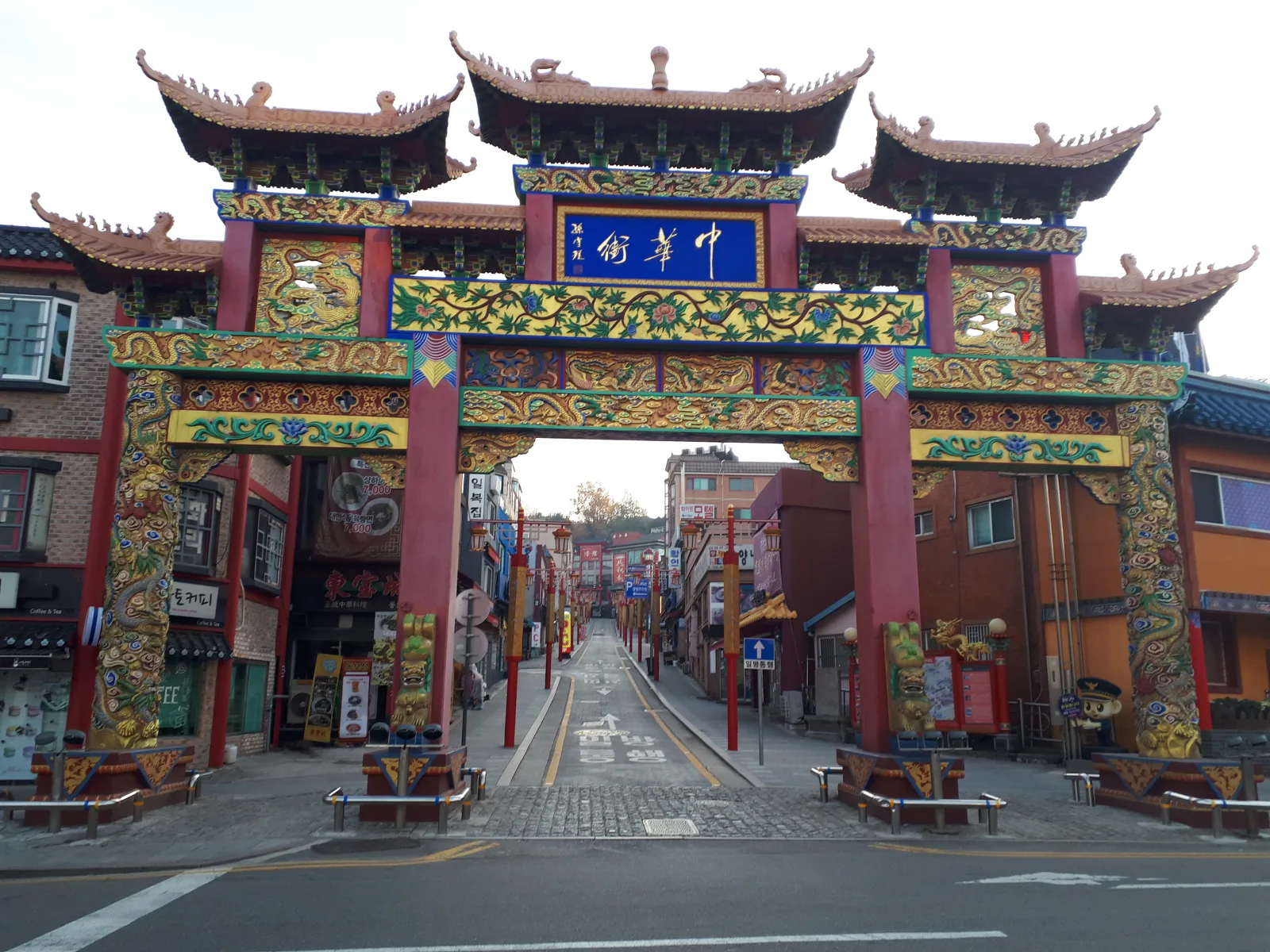
Chinatown grew out of the Qing (Chinese) concession set up in 1884 in what is now Seollin-dong.8 Back then the sea came right up to where the First Paifang gate stands today, so the best land for trading was this hillside.9 That's why the main street behind the gate climbs for about 300 meters.
The street also has the Jajangmyeon Museum, in the old Gonghwachun building, often named as Korea's first Chinese restaurant. It keeps the same hours as the other museums, and adult entry is ₩1,000.10 If it rains, the Incheon Overseas Chinese History Museum inside the Korea-China Cultural Center is another indoor stop. It opened in 2015 as the country's first museum about Korea's ethnic Chinese community.11
This plan gives Chinatown only half an hour. If jajangmyeon, the black-bean noodles invented in this neighborhood, is the reason you came, the same review roundup suggests a weekday over a weekend.
The boundary stairs: Qing on the left, Japan on the right
Qing-Japanese Concession Boundary Stairs
- Incheon city monument
- Always open
- Free
The Open Port once held three concessions, enclaves where foreign powers ran their own administration and police. Japan set up its concession in 1883 around what are now Gwan-dong and Jungang-dong, about 23,000 square meters (5.7 acres). Qing China followed in 1884 with about 16,500 square meters (4 acres) around Seollin-dong.12 The hill around Jayu Park belonged to a general concession shared by Western nations. The Qing and general concessions were abolished in 1913.13
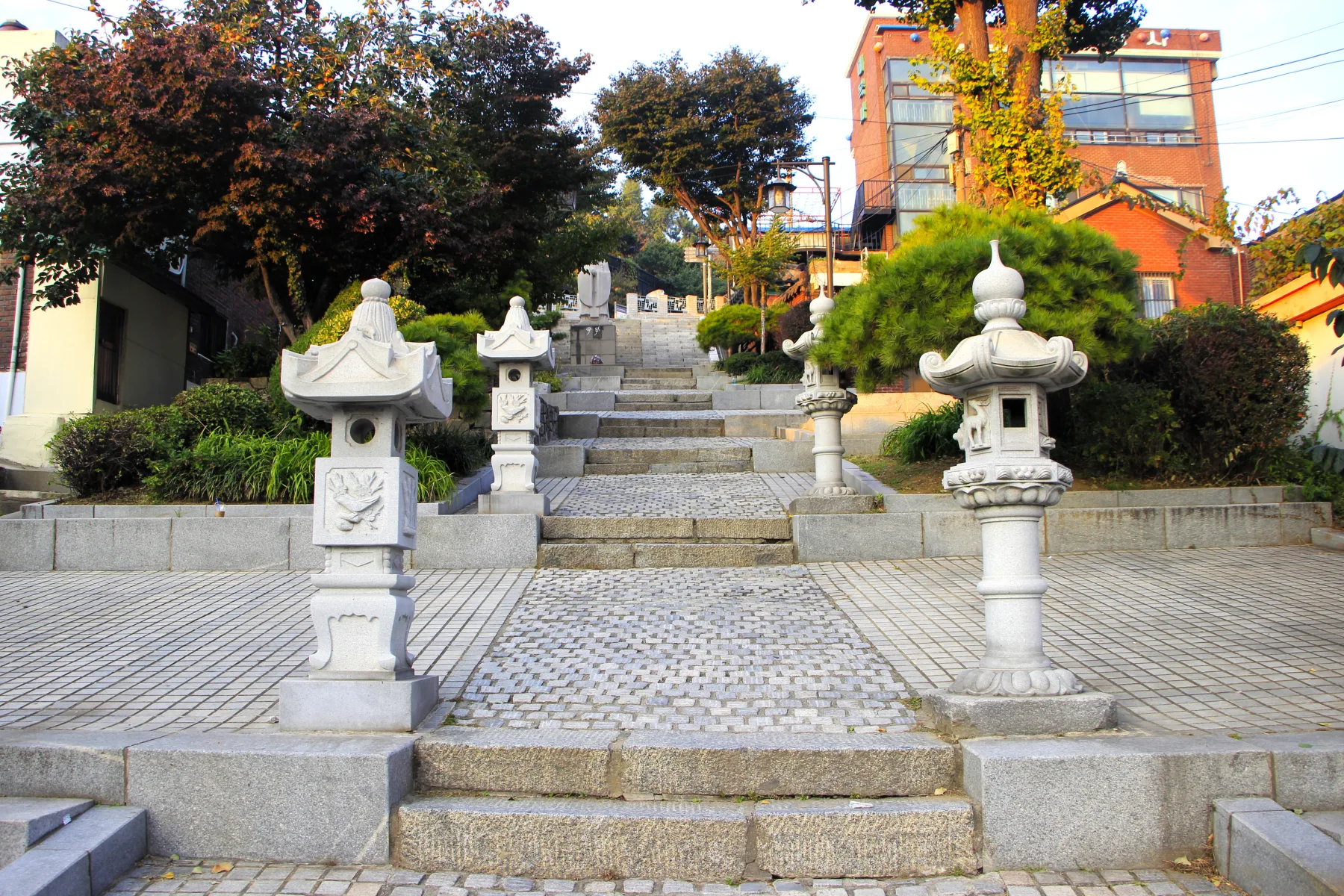
From the Chinatown street, a steep flight of stone steps climbs the hill where the two concessions met. The stairs became an Incheon city monument in 2002.14 Looking up from the bottom, the old Qing concession is on your left and the Japanese one on your right. The stone lanterns differ as well, square Chinese ones on one side and lotus-topped Japanese ones on the other.15
The lanterns are a recent addition. Incheon Today reported that some historians criticize them as placed without historical research.16 The same article dates the stairs to the late 1880s or early 1890s and says they weren't built to divide the concessions. They became a boundary as Chinese and Japanese buildings went up on either side of the path.
The photo at the top shows the stairs on the afternoon of October 21, 2022. The white figure at the top is a statue of Confucius, a gift from the Chinese city of Qingdao in June 2002.17 Flat landings break up the climb, so take it in stages.
From the top of the stairs to Jayu Park
Jayu Park
- Open 24 hours
- Free
The stairs come out on Jayu Park's main plaza. The park began in 1888 as Gakguk Park, the "park of all nations," laid out by diplomats from several countries for the foreigners living in the concessions, and it was Korea's first Western-style park. It became West Park in 1914 and Manguk Park after liberation in 1945. It took its current name, which means Freedom Park, in 1957, when a statue of General Douglas MacArthur went up.18 The Korea-U.S. Centennial Monument from 1982 stands near the top. The park is open around the clock, and entry is free.19
The observation deck looks out over Incheon's inner harbor. One traveler who went on a freezing weekday afternoon in winter wrote that the streets and restaurant lines below were busy, while few people made the climb.20 If the climb doesn't suit your group, skip the park. A step-free route up isn't confirmed.
Jemulpo Club, before the lunch break
Jemulpo Club
- 9:30 a.m. to 5:30 p.m.
- Closed noon to 1 p.m.
- Closed Mondays
- Free
Heading down from the park toward the sea, you pass a white two-story building. Foreign residents of the concessions, among them Americans, Britons, Germans, French and Russians, built it in 1901 as a social club. It housed the Incheon Municipal Museum from 1953 to 1990, and today you can look around for free.21
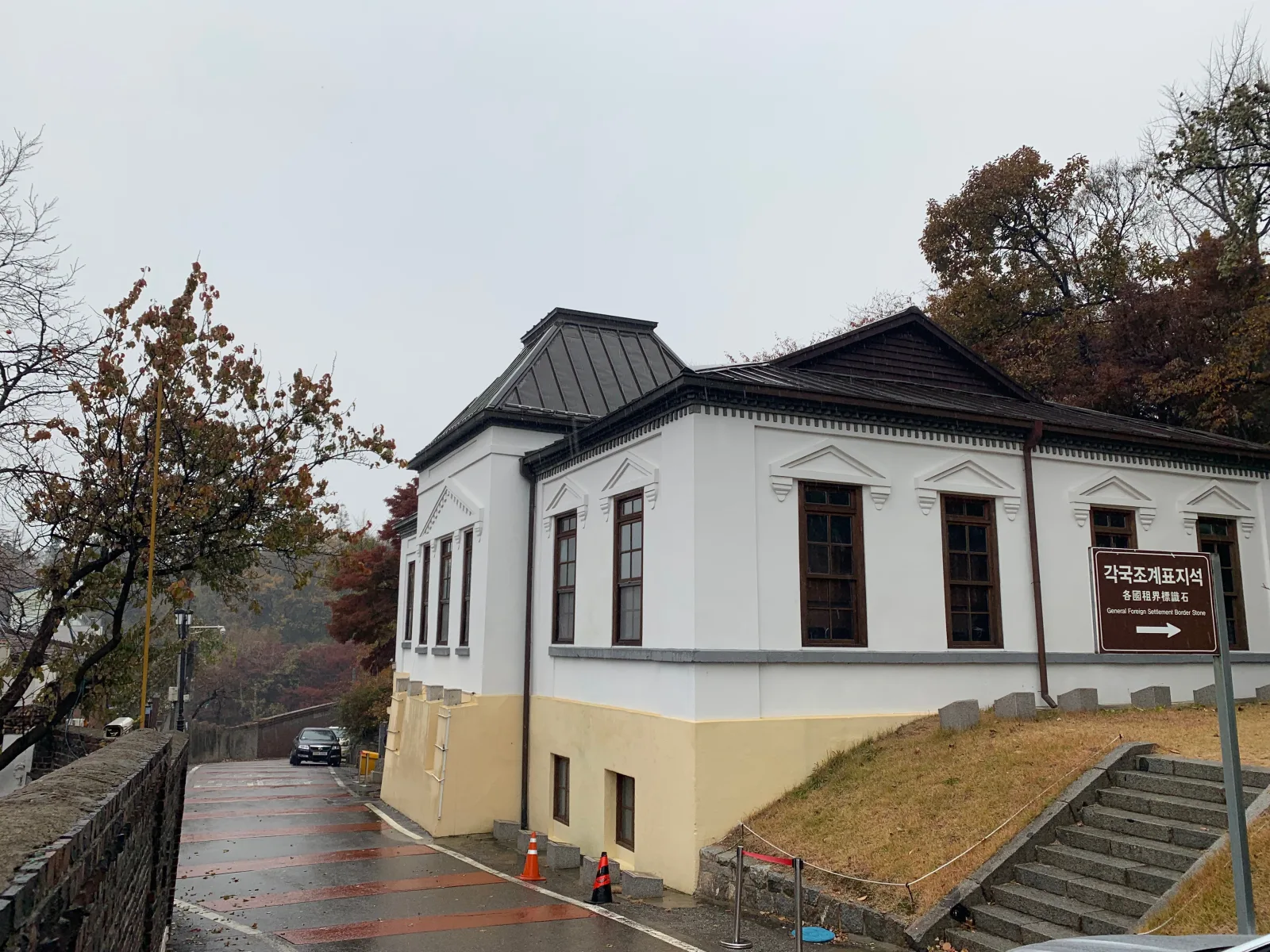
The club had a lounge, a library and a billiard table, and its tennis court stood where a district education office is now. The bay that projects from the middle of the front once held the main door, reached by outdoor stairs that were removed when a road was cut through in the late colonial period. A replica of a stone that marked the general concession's boundary stands on the open ground beside the building; the original belongs to the Incheon Municipal Museum.22 The sign on the right of the photo below points the way to it.
Incheon City's English listing says the club closes for lunch from noon to 1 p.m., which is why the sample plan gets you there before noon.23
Choose one museum
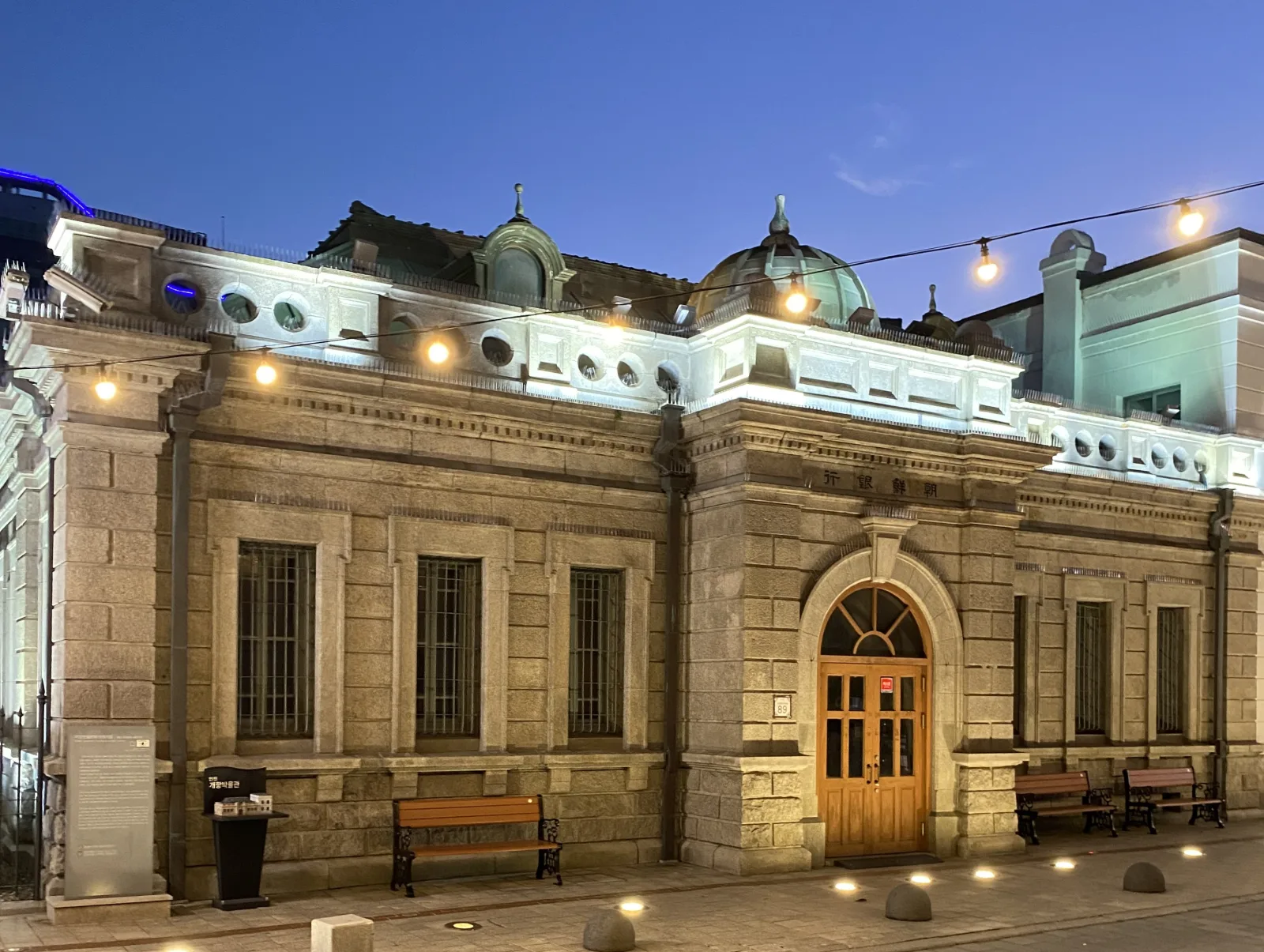
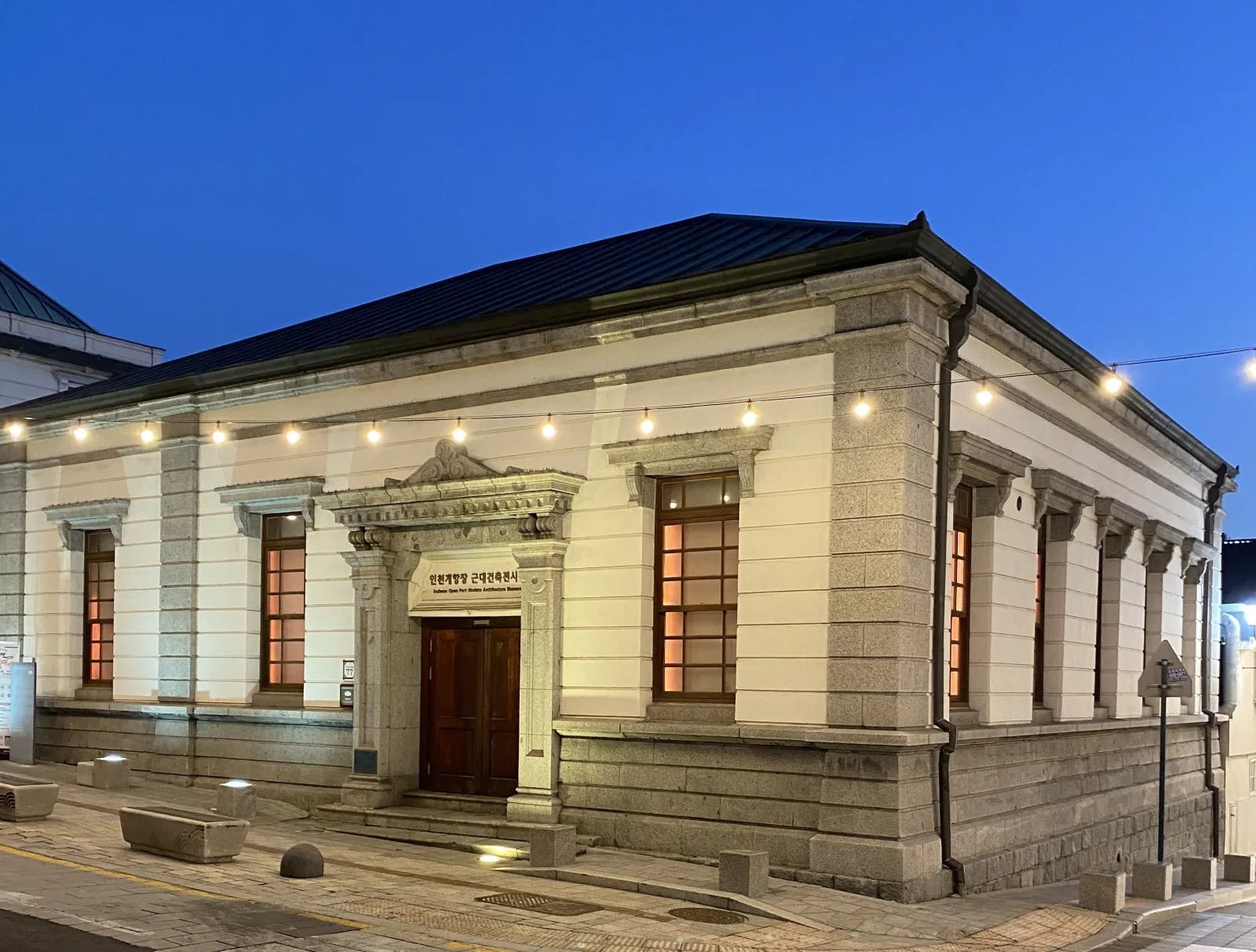
Below the Jemulpo Club, two former bank buildings stand side by side on Sinpo-ro 23beon-gil. They share hours and prices, so the choice comes down to subject. Pick the Incheon Open Port Museum for the story of the port and the city after 1883, or the Modern Architecture Exhibition Hall for the streets and buildings, including the ones that are gone. You can do both, but every extra hour comes out of the market and the Art Platform.
The Incheon Open Port Museum, for the port's story
Incheon Open Port Museum
- Tue to Sun, 9 a.m. to 6 p.m.
- Last entry 5:30 p.m.
- Adults ₩500
This was the Incheon branch of Japan's First Bank, a stone building with a small dome over the middle. Apart from sand, gravel and lime, its building materials were shipped over from Japan.24 It's a designated cultural heritage site of Incheon and has been a museum since 2010. Four permanent galleries cover the port after it opened in 1883, the Gyeongin Line (Korea's first railroad, opened in 1899), a scale model of the concession streets and the bank itself.25
The Modern Architecture Exhibition Hall, for the buildings
Open Port Modern Architecture Exhibition Hall
- Tue to Sun, 9 a.m. to 6 p.m.
- Last entry 5:30 p.m.
- Adults ₩500
Next door is the former Incheon branch of Japan's 18th Bank. Its walls, roof structure and vault survive, and it has been an exhibition hall since 2006. Scale models and videos show the modern buildings that still stand alongside ones that have disappeared, which is a good way to retrace the hill and streets you've just walked.26
Late lunch at Sinpo International Market
Sinpo International Market
- 179 shops
- Arcade roof over the lanes
Sinpo International Market is about 600 meters from the museums in a straight line. It started in the late 19th century with traders who bought fish at Jemulpo and resold it here. Public seafood and produce markets opened in 1929 and 1932, and a new market building in 1970 made it the permanent market it is today. It now has 179 shops, best known for dakgangjeong, sticky sweet-and-spicy fried chicken, and gonggalppang, a hollow, crackly bread. The head of the merchants' association says Sinpo-dong is where jjolmyeon, chewy cold noodles, were first made, and the market is developing new jjolmyeon dishes.27
The lanes have an arcade roof, which makes the market an easy lunch stop in the rain. A support center inside has space to rest and expanded public restrooms.28 Incheon City also lists restrooms at the Jemulpo Club.29 Each shop sets its own hours and closing days, so check ahead if you have one in mind.
Past the Art Platform and back to the station
Incheon Art Platform
- Converted port warehouses
- About 500 m from Incheon Station
On the way back toward Incheon Station you pass Incheon Art Platform, where the port's old storage warehouses were turned into an arts center and paths run between red-brick buildings.30
From October 29 to November 15, 2026, its Project Space (E2) shows "Interval," a solo exhibition by Shiu Jui-tsz, an artist from Taiwan in residence there. The five works grew out of the artist's visits to Sinpo Market and the fish market near the international ferry terminal after the vendors had gone home, so the show picks up where your lunch stop left off. It's open Tuesday through Sunday from 11 a.m. to 6 p.m. and closed Mondays.31 After that, check the Art Platform's current exhibitions before you go.
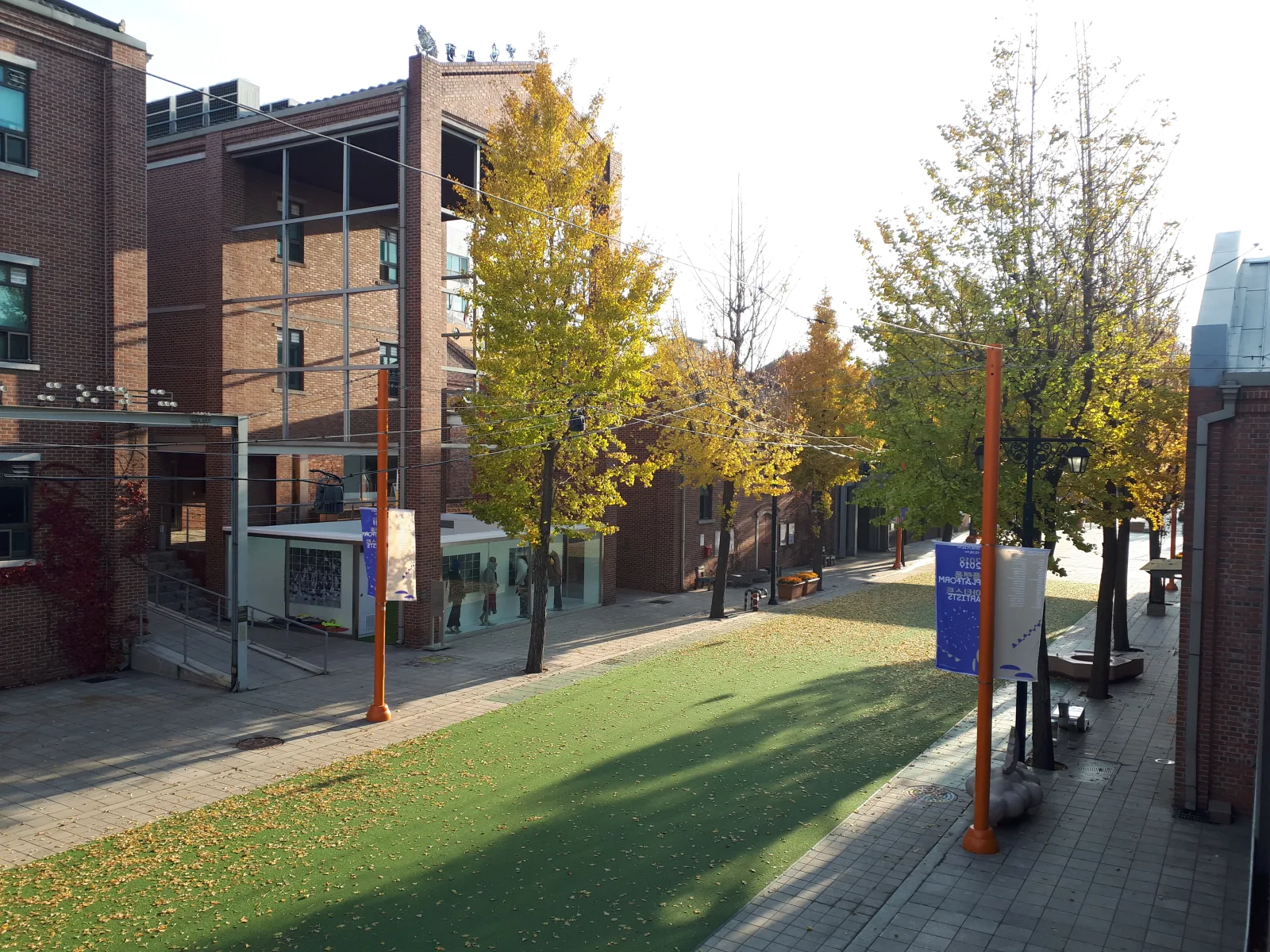
The photo of the ginkgo trees is from November 23, 2019. The Korea Forest Service expected ginkgo color to peak nationwide around October 30 this year and gave no separate date for Incheon.32
From the Art Platform, Incheon Station is about 500 meters away in a straight line. Skipping the hill saves about 45 minutes, and seeing both museums adds about an hour, so trim or add a stop to suit your legs and the weather.
Places and visitor information
- Jemulpo Cultural Foundation, Incheon Open Port Museum (Korean)
- Jemulpo Cultural Foundation, Modern Architecture Exhibition Hall (Korean)
- Jemulpo Cultural Foundation, museum admission guide (Korean)
- Incheon Tour, Open Port walking course (Korean)
- Korea Tourism Organization, Incheon Jayu Park
- Korea Tourism Organization, Jemulpo Club
- Incheon Metropolitan City, Jemulpo Gurabu
- Incheon Art Platform, Shiu Jui-tsz solo exhibition "Interval" (Korean)
- Korea Heritage Service portal, Qing-Japanese concession boundary stairs (Korean)
- National Museum of Korean Contemporary History archive, Chinatown (Korean)
- National Folk Museum of Korea webzine, Incheon Chinatown (Korean)
- Kyeonggi Ilbo, report on the launch of Jemulpo-gu (Korean)
- Kyeongin Ilbo, Incheon heritage series on the concession stairs (Korean)
- Kyeongin Broadcasting, report on the concession stairs (Korean)
- Incheon Today, the concession stairs and Hongyemun (Korean)
- Segye Ilbo, Open Port walking tour feature (Korean)
- Incheon Ilbo, Incheon traditional market series on Sinpo (Korean)
- Pressian, report on the Open Port parking garage (Korean)
- Kyunghyang Shinmun, report on the 2026 foliage forecast (Korean)
- Korea Insider, Incheon Chinatown review roundup
- xtintina, Incheon Chinatown and Jayu Park