A rainy half-day in Jeju City's old town: where to start and where to duck inside
Start at Gwandeokjeong Pavilion and the old government compound, walk the roofed Chilseong-ro arcade to Dongmun Market, and move into a gallery, a memorial hall or the Jeju National Museum as the rain picks up. Includes November hours and the Monday closures.
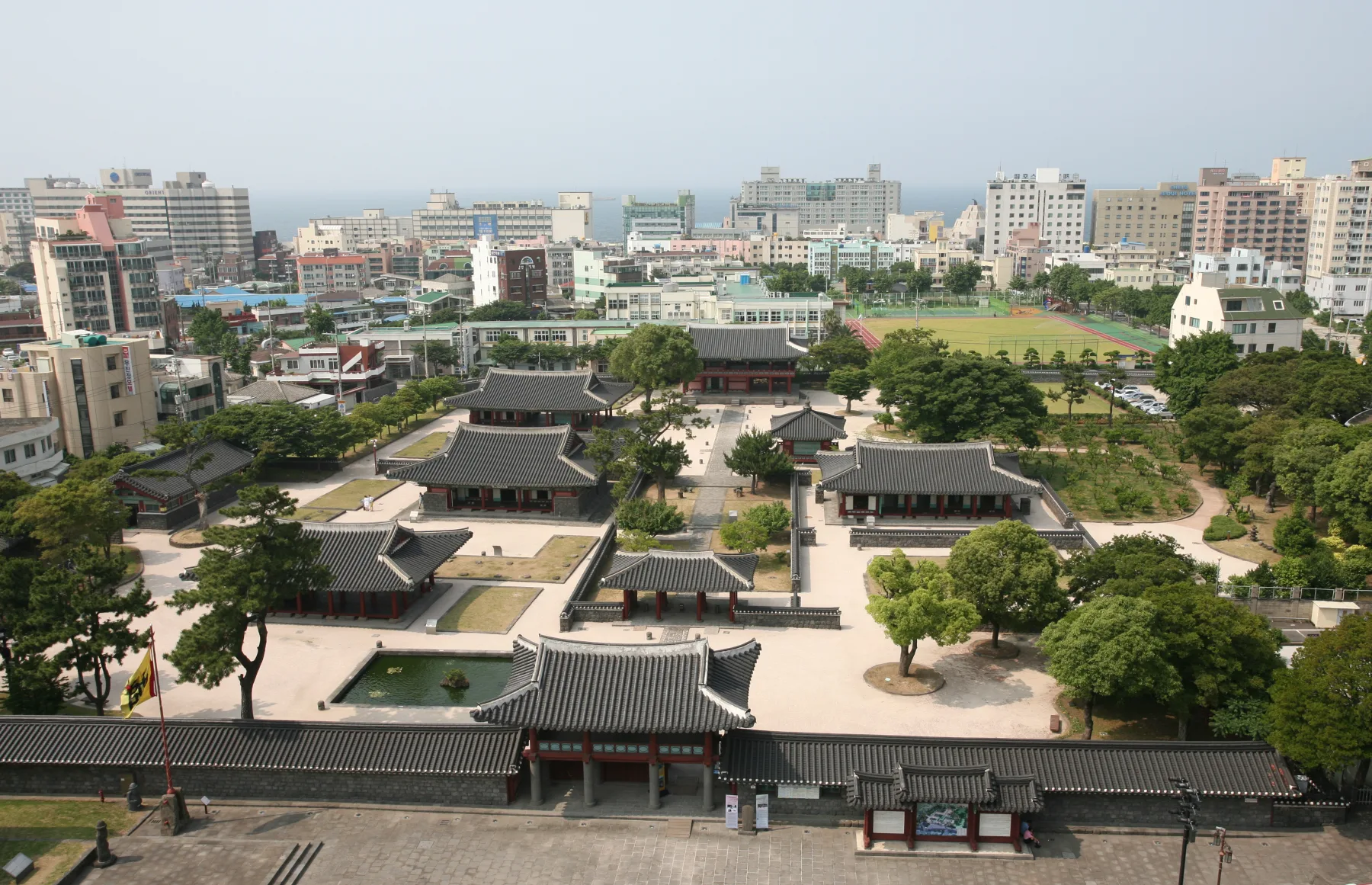
Rain doesn't have to cancel a half-day in Jeju City's old town. Start at Gwandeokjeong Pavilion and the Jejumok-gwana government compound, walk under the arcade roof of Chilseong-ro to Dongmun Market for lunch, and duck into Sanjicheon Gallery or the Kim Man-deok Memorial Hall nearby when the rain gets heavier. If it looks set to rain all day, finish at the Jeju National Museum. In November, Jeju City averages 9.8 days with at least 0.1 mm of rain, roughly one day in three.1 Pick your day with care: on Mondays, the gallery, the memorial hall and the museum are all closed.
Let the rain choose the order
Gwandeokjeong is less than 500 meters from Dongmun Market in a straight line, and the gallery is within 500 meters of the market. Only the museum is farther, a little over 2 km to the east, so take a taxi there if the rain is heavy. These timings allow for unhurried looking and lunch.
A half-day for each kind of rain
- Rain
- On and off
- Order
- Gwandeokjeong, Jejumok-gwana, Chilseong-ro, Dongmun Market
- Allow
- 2.5 to 3 hours
- Rain
- Getting heavier
- Order
- Manggyeongru at Jejumok-gwana, Chilseong-ro, Dongmun Market, then Sanjicheon Gallery or the Kim Man-deok Memorial Hall
- Allow
- About 3 hours
- Rain
- All day
- Order
- Lunch at Dongmun Market, then the Jeju National Museum
- Allow
- 3 to 4 hours
| Rain | Order | Allow |
|---|---|---|
| On and off | Gwandeokjeong, Jejumok-gwana, Chilseong-ro, Dongmun Market | 2.5 to 3 hours |
| Getting heavier | Manggyeongru at Jejumok-gwana, Chilseong-ro, Dongmun Market, then Sanjicheon Gallery or the Kim Man-deok Memorial Hall | About 3 hours |
| All day | Lunch at Dongmun Market, then the Jeju National Museum | 3 to 4 hours |
Start at Gwandeokjeong
Gwandeokjeong Pavilion
- Built in 1448
- Designated Treasure
Jeju's magistrate Sin Suk-cheong built Gwandeokjeong in 1448 as a place to train soldiers, and Visit Jeju describes it as the oldest surviving building on the island.2
The square in front of it is also where Jeju 4·3 began. On March 1, 1947, after a rally marking the anniversary of Korea's 1919 independence movement, armed police near Gwandeokjeong fired on the crowd and killed six residents. The Jeju 4·3 Peace Foundation dates 4·3 from this shooting: years of armed conflict and crackdown on the island, lasting until 1954, in which a great many residents were killed.3
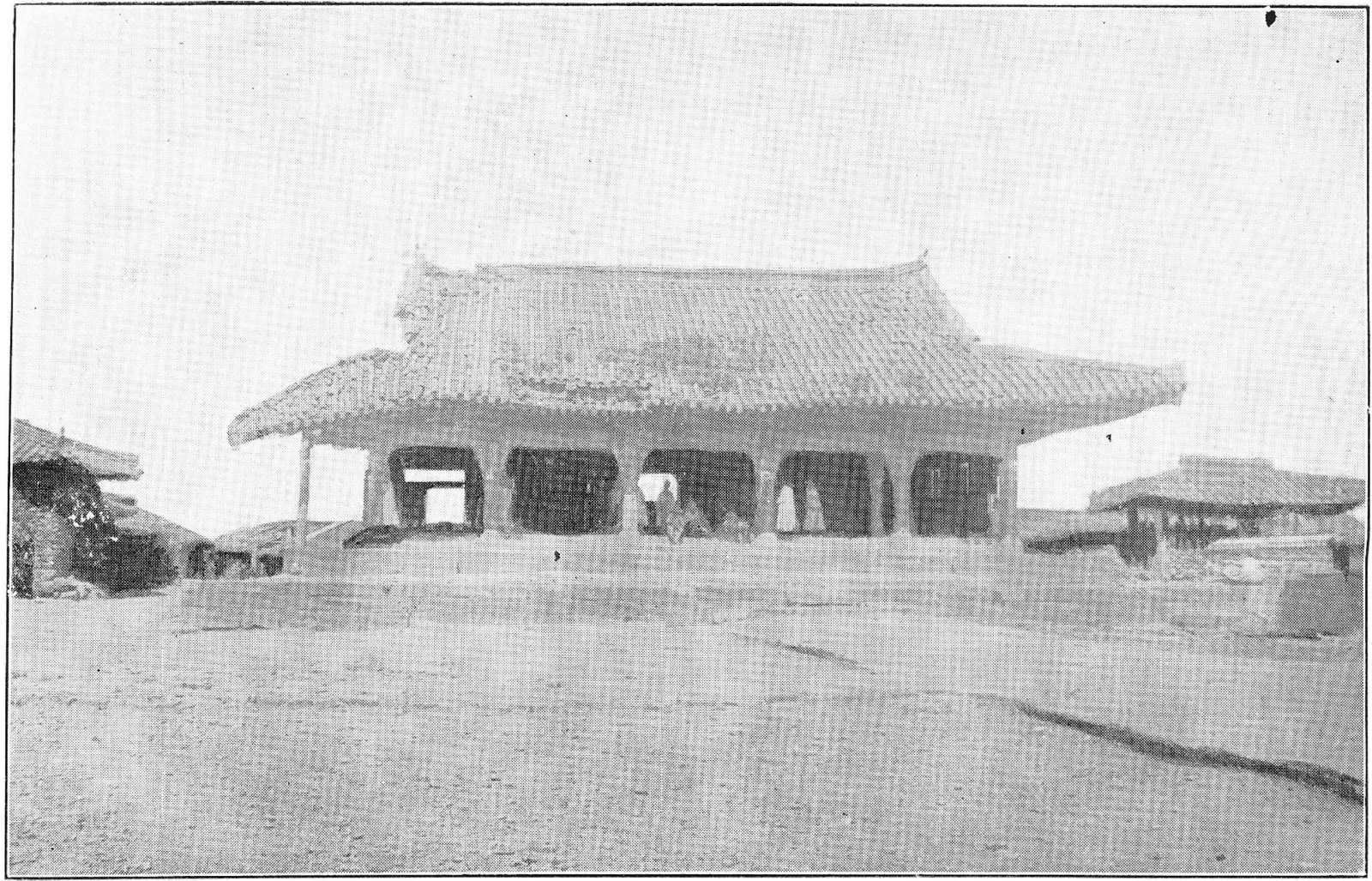
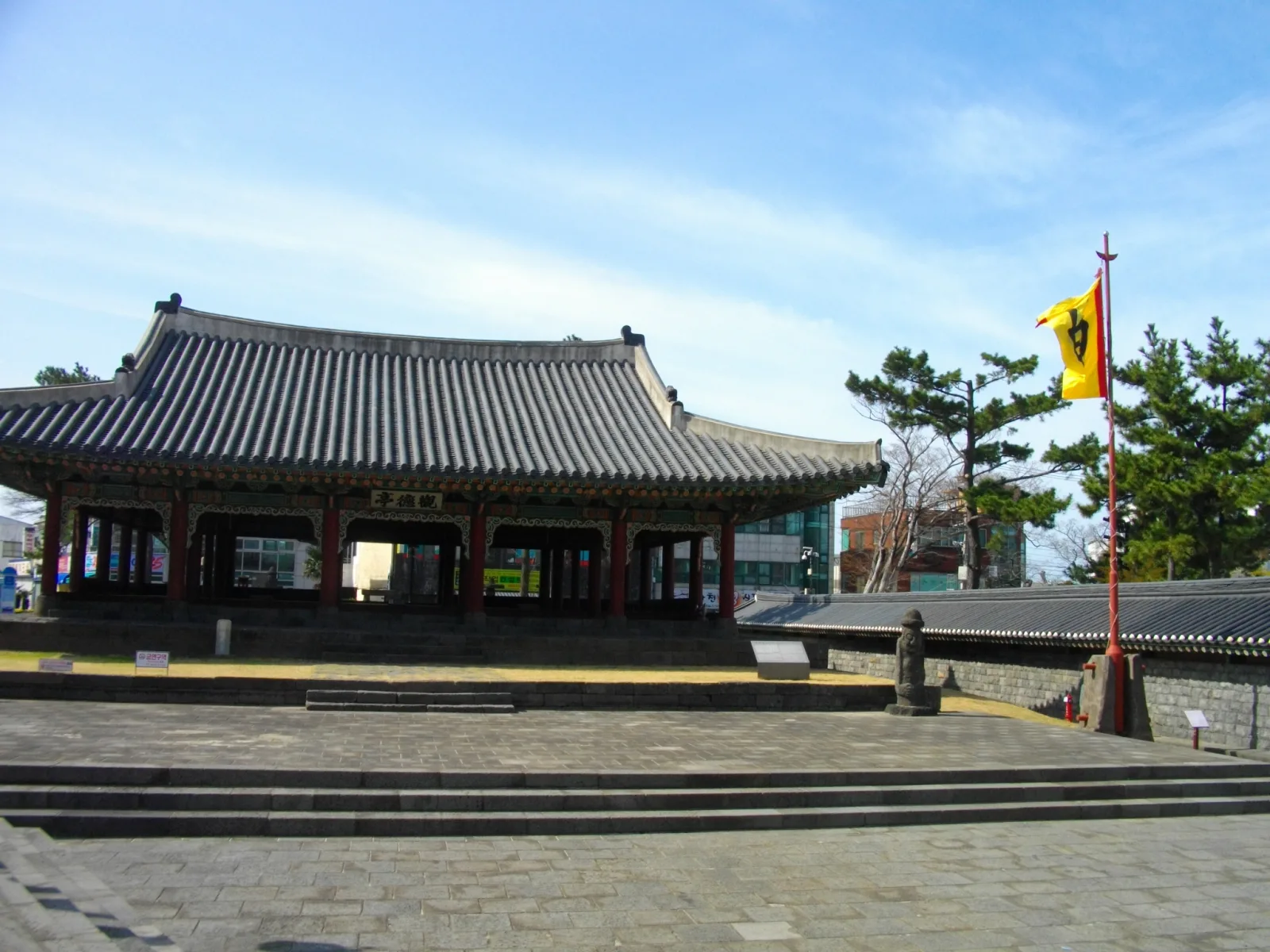
The two photos below show Gwandeokjeong as printed in a book published in 1924 and as it looked in 2014. The older picture has a bare-earth square with low roofs on either side; the 2014 picture has paving stones, a dolhareubang (a Jeju stone guardian figure) and buildings rising behind the pavilion. A photo from where you stand today would make a third.
When the rain picks up, go inside Manggyeongru
Jejumok-gwana
- 9 a.m. to 6 p.m.
- Last entry 5:30 p.m.
- Open daily
- Adults ₩1,500
Next door, Jejumok-gwana was the seat of Jeju's government in the Joseon era. Its buildings were torn down under Japanese colonial rule. After four rounds of excavation starting in 1991, the compound was rebuilt in 2002 from the foundation stones that turned up and from old records such as Tamna Sullyeokdo, an illustrated album painted in 1703.4
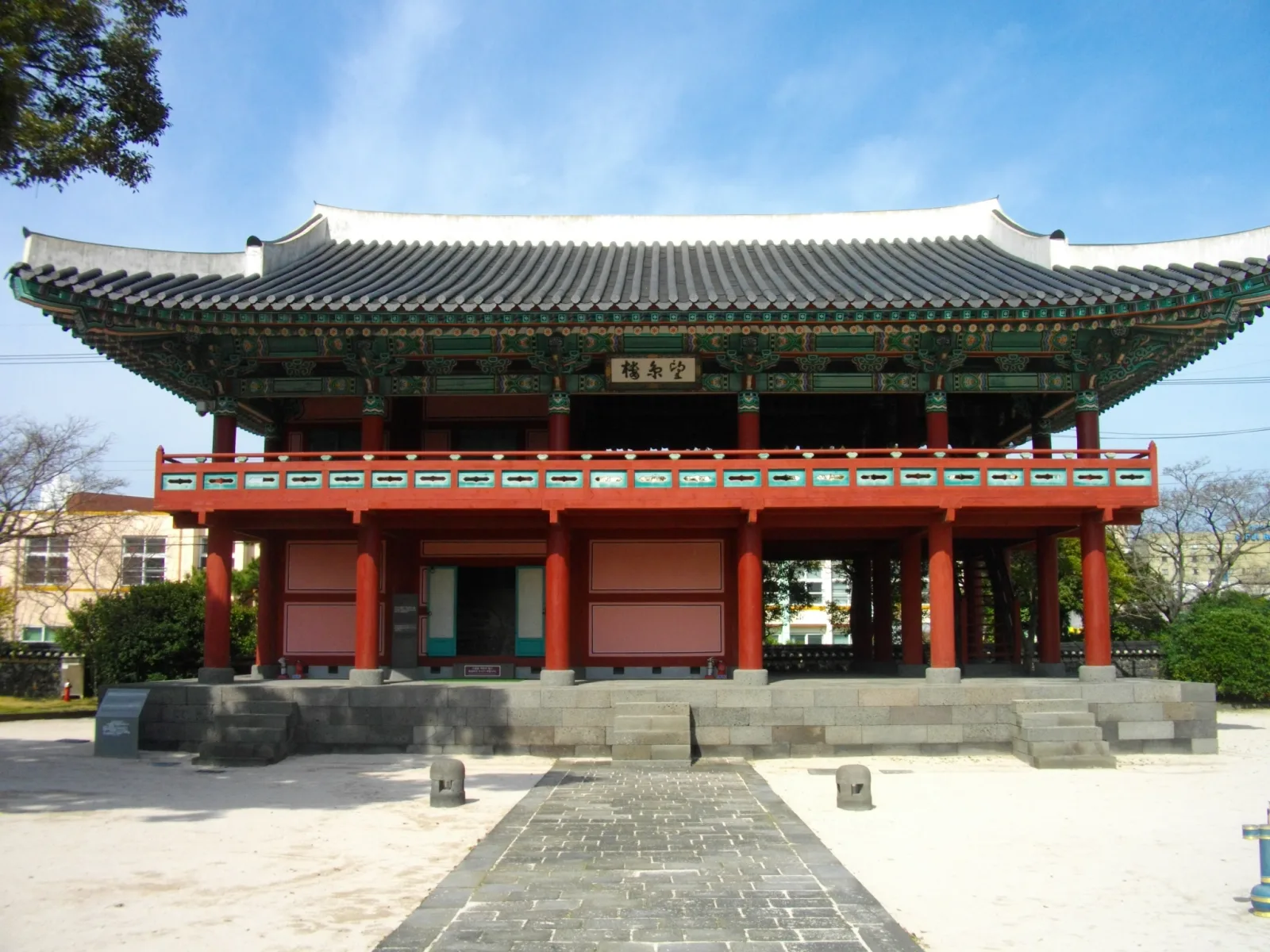
If the rain gets heavier, head for Manggyeongru, the two-story pavilion. Its ground floor holds an exhibit on Tamna Sullyeokdo, with graphic panels and video showing Jeju about 300 years ago.5 You're seeing the pictures that helped rebuild the compound from inside the compound itself.
The compound is open daily from 9 a.m. to 6 p.m., with last entry at 5:30 p.m. Admission is ₩1,500 for adults aged 25 to 64, ₩800 for ages 13 to 24 and ₩400 for ages 7 to 12. Children 6 and under, Korean nationals 65 and over, and Jeju residents get in free.6 Visit Jeju lists guided tours you can book from 10 a.m. to 5 p.m., but the compound's own visitor page doesn't list tour times, so call +82-64-710-6717 before counting on one. If you're driving, note that the compound's parking lot has been closed for excavation since May 2023; Visit Jeju points drivers to the paid public lot west of Gwandeokjeong.7
Under the Chilseong-ro arcade to Dongmun Market
Dongmun Market
- 7 a.m. to 9 p.m. (varies by shop)
- Open every day
- Night market Nov to Apr: 6 p.m. to midnight
Dongmun Market is about 470 meters from the compound in a straight line. Chilseong-ro, the shopping street in between, has an arcade roof along its full 435 meters, finished in December 2008. In August, a local outlet reported that the street's merchants' cooperative had applied for 2027 modernization funding to remove the arcade over its first two blocks, and that the application was under review.8
The market is open every day of the year, holidays included, on average from 7 a.m. to 9 p.m., though each shop keeps its own hours. With 12 entrances, it helps to remember the gate number you came in by. The food alley runs between gates 8 and 10, and from November to April a night market sets up near gate 8 from 6 p.m. to midnight, closing early when stalls sell out.9 Bring some cash: a Korean travel guide notes that most shops deal in cash and only some take bank transfers.10
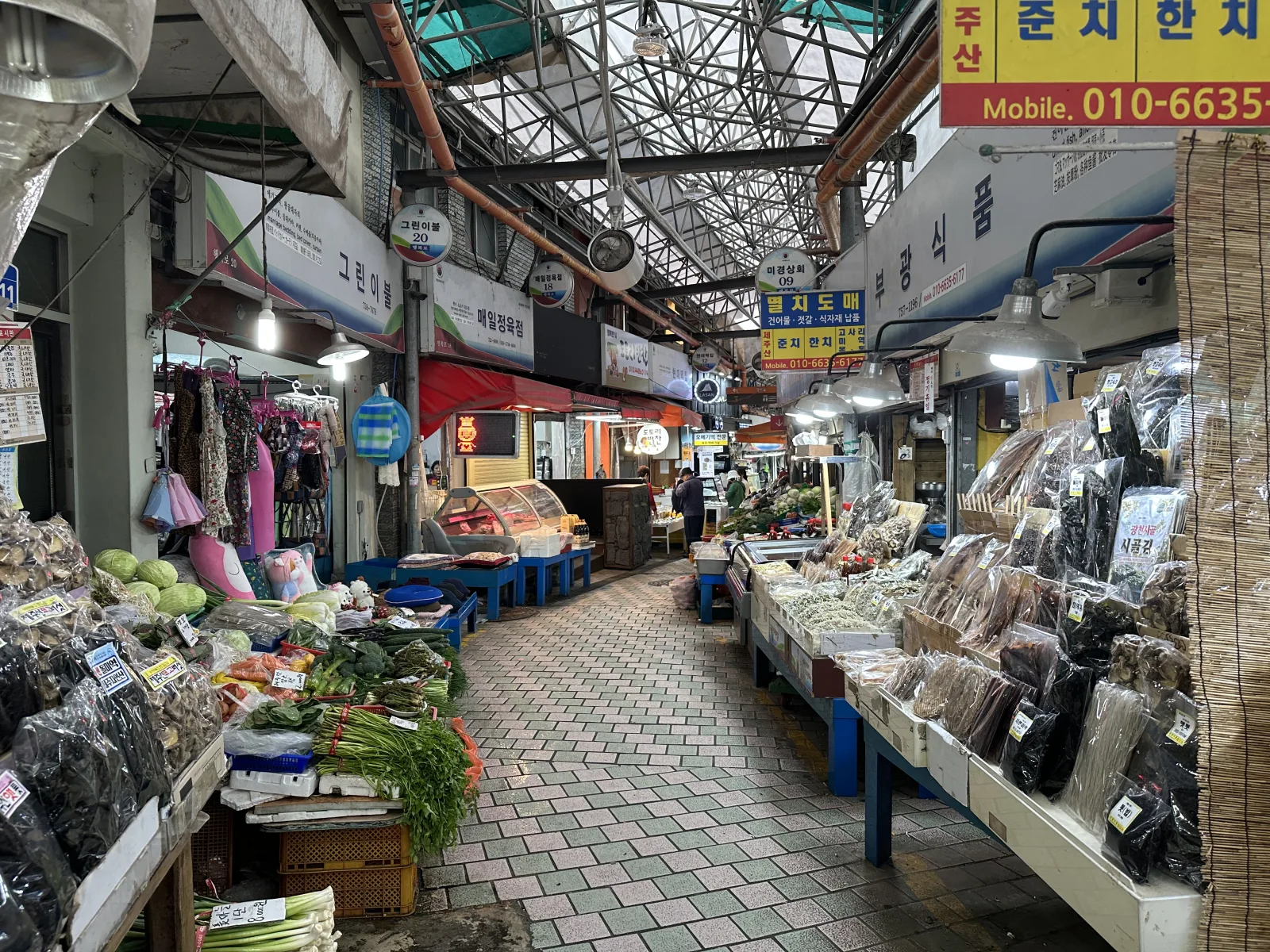
In a roofed lane like this one, you can fold your umbrella while you shop. You'll need it again once you step out of the market.
Duck into Sanjicheon Gallery
Sanjicheon Gallery
- 10 a.m. to 6 p.m.
- Closed Mondays and holidays
- Free
Northeast of the market on the Sanjicheon stream, Sanjicheon Gallery joins two former inn buildings into one exhibition space. Visit Jeju describes it as a gallery devoted to the work of Jeju photographers.11 Entry is free, and it's open 10 a.m. to 6 p.m. Sources give last entry as either 5 p.m. or 5:30 p.m., so arrive before 5.12
What the second- to fourth-floor galleries are showing in November isn't confirmed. On the ground floor, the window gallery shows "Red Room," five works by an artist who explores what photography can do, from October 28 through February 28, 2027. You can see them through the glass wall facing the stream at any hour, even when the gallery is closed.13
Borrow a stroller at the Kim Man-deok Memorial Hall
Kim Man-deok Memorial Hall
- 9 a.m. to 6 p.m.
- Closed Mondays
About 200 meters from the gallery, the Kim Man-deok Memorial Hall honors a Joseon-era woman merchant from Jeju remembered for sharing her wealth. It's open 9 a.m. to 6 p.m. and closed on Mondays, January 1, and the days of Seollal (Lunar New Year) and Chuseok (the autumn harvest holiday). When a Monday is a public holiday, it opens that day and closes the next. Wheelchairs and strollers are available to borrow, which helps if you're out with a small child.14
If the rain won't stop, the Jeju National Museum
Jeju National Museum
- Tue to Sun: 9 a.m. to 6 p.m.
- Last entry 5:30 p.m.
- Closed Mondays
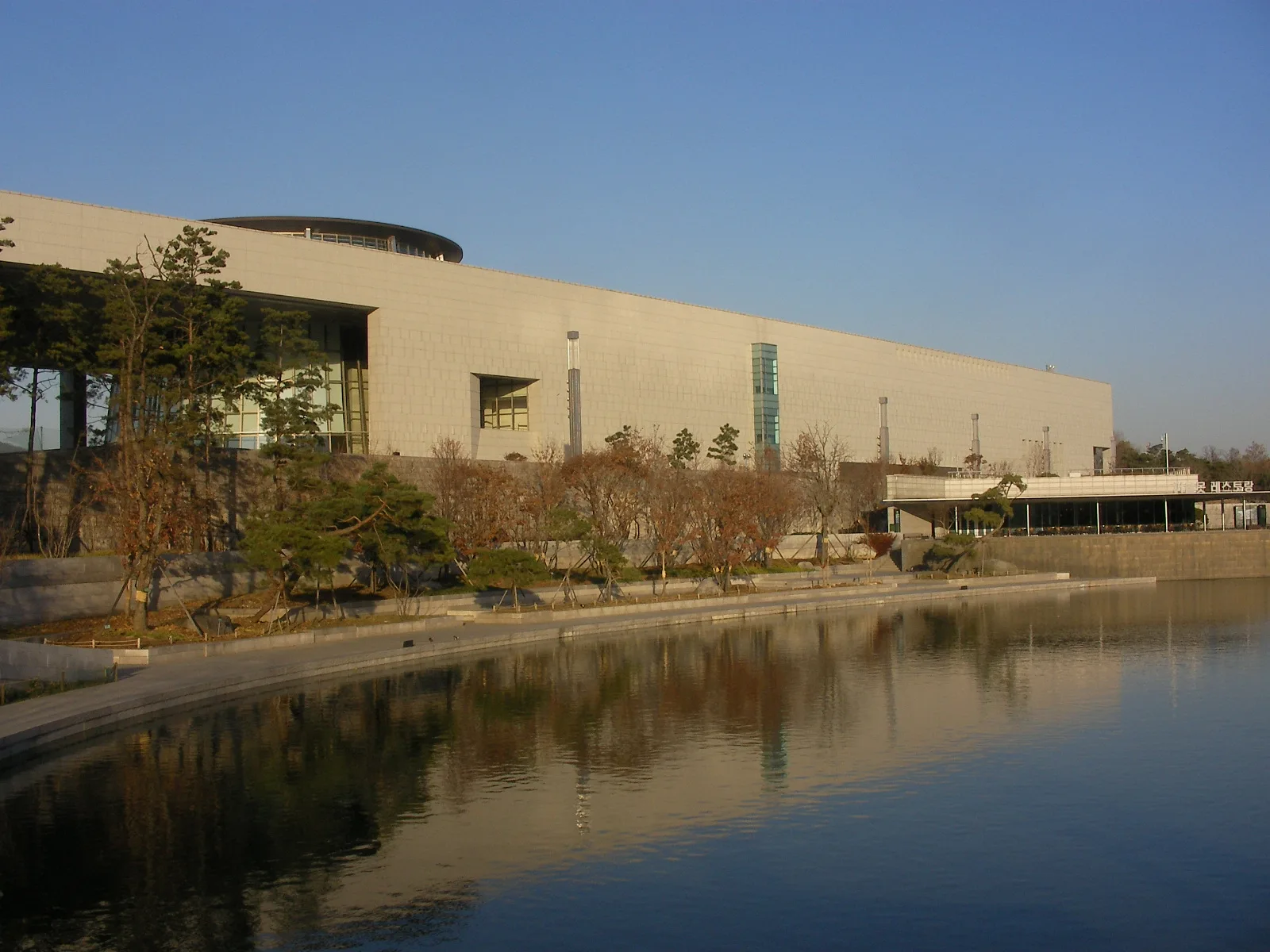
On a day of steady rain, spend the rest of your time at the Jeju National Museum, a little over 2 km east of Dongmun Market. It's open Tuesday through Sunday from 9 a.m. to 6 p.m., with last entry at 5:30 p.m., and closed on Mondays, January 1, Seollal and Chuseok.15 Admission is free, though the museum notes that special exhibitions may charge; call +82-64-720-8000 to check.16
In November the museum is showing "Eternity in a Moment, Capturing Jeju," an exhibition of photographs donated from the collection of the late Kim Young-gap (1957 to 2005), who spent his life photographing Jeju's landscapes and the lives lived among them. It runs in the special exhibition hall and brand hall through March 1, 2027, and the museum says the works in parts two and three change over in November.17 The permanent People of Jeju Island gallery, meanwhile, is closed for the exhibition until March 22, 2027.18
Everything from Gwandeokjeong to the Kim Man-deok Memorial Hall lies within about a kilometer in a straight line, so you can move between stops whenever the rain eases. A folding umbrella and a bag to hold it when it's wet make going in and out of galleries easier.
Places and opening information
- Visit Jeju, Gwandeokjeong (in Korean)
- Jeju 4·3 Peace Foundation, What is Jeju 4·3 (in Korean)
- Jejumok-gwana, admission and hours (in Korean)
- Jejumok-gwana, history hall (in Korean)
- Jejumok-gwana, Tamna Sullyeokdo exhibit (in Korean)
- Visit Jeju, Jejumok-gwana (in Korean)
- Media Jeju, report on the Chilseong-ro arcade review (in Korean)
- Visit Jeju, Dongmun Traditional Market (in Korean)
- Tripsoda, six markets to visit in Jeju (in Korean)
- Visit Jeju, Sanjicheon Gallery (in Korean)
- Korea Union News, Sanjicheon Gallery exhibition notice (in Korean)
- Headline Jeju, Sanjicheon Gallery window exhibition (in Korean)
- Visit Jeju, Kim Man-deok Memorial Hall (in Korean)
- Jeju National Museum, visitor information (in Korean)
- Jeju National Museum, English site
- Jeju National Museum, Kim Young-gap donation exhibition (in Korean)
- Jeju National Museum blog, temporary gallery closure
- Wikipedia, Jeju City climate table